
How to Report a Timeshare Company for Fraud or Misrepresentation
If you believe you were lied to, pressured, or misled during your timeshare purchase, you may be wondering how to report a timeshare company for fraud, and whether doing so will actually accomplish anything. It can. Formal complaints create a paper trail that regulators, attorneys, and even the resort itself take seriously, especially when a pattern of complaints builds up against the same company or salesperson, and that record often becomes the foundation for a stronger case down the line.
Here’s a clear, step-by-step path for reporting timeshare fraud the right way, along with what you can realistically expect at each stage and how it connects to a broader legal strategy if you decide to pursue one.
What Counts as Timeshare Fraud or Misrepresentation?
Not every disappointing timeshare experience rises to the level of fraud, but many more situations qualify than owners realize, and it’s worth reading through the examples below with your own purchase experience in mind rather than assuming the bar is higher than it actually is. Common examples include being told the timeshare was a guaranteed financial investment, being promised that maintenance fees would never increase, being rushed through paperwork without time to read it, or having your signature obtained on documents you didn’t fully understand.
- Being told the property would appreciate in value or could easily be resold for a profit.
- Being promised a fixed maintenance fee that later increased well beyond what was described.
- Being pressured through hours-long sales presentations with no reasonable opportunity to leave or think it over.
- Discovering terms in the contract that were never mentioned verbally during the sales pitch.
- Being told you were simply signing a survey, a prize entry, or paperwork unrelated to an actual purchase.
If any of this sounds familiar, it’s worth taking the reporting process seriously rather than assuming nothing can be done about it after the fact.
Step 1: Document Everything First
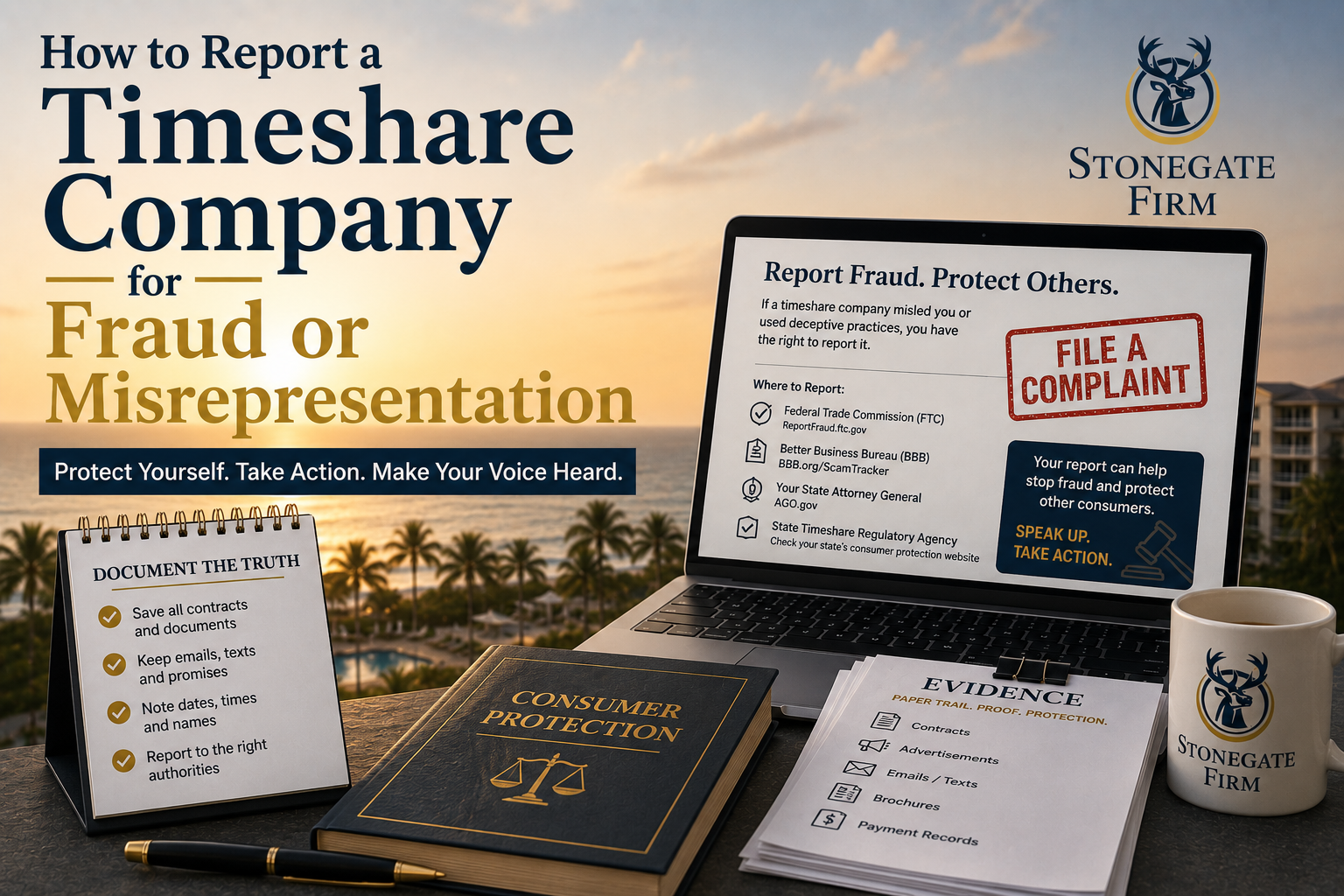
Before filing anything, gather your original contract, any marketing materials from the sales presentation, receipts, and notes on what you were told verbally, including the date, time, and the name of the salesperson if you remember it. Detailed documentation is what turns a complaint into something regulators and attorneys can actually act on.
If it’s been a while since your purchase, don’t worry if your memory of specific details is fuzzy. Write down what you do remember while it’s fresh, and don’t assume a gap in your paperwork disqualifies your complaint entirely. Resorts and regulators both understand that consumer memory isn’t perfect, especially years after a high-pressure sales presentation.
Step 2: Report Timeshare Fraud to Your State Attorney General
Every state has a consumer protection division within the Attorney General’s office, and timeshare complaints are exactly the kind of case they handle. Filing here creates an official record and, if enough complaints accumulate against the same company, can trigger a broader investigation. Most states allow you to file online, and the process typically takes less than thirty minutes.
Step 3: File a Complaint with the FTC
The Federal Trade Commission accepts consumer fraud complaints nationally, including those related to timeshare sales and timeshare exit companies. Filing with the FTC doesn’t resolve your individual case directly, but it adds to a national database that regulators use to identify patterns of abuse: Click here.
Because the FTC operates at a federal level, this step matters even if your state’s Attorney General’s office is slow to respond. A pattern of complaints across multiple states against the same company is often what triggers larger regulatory action.
Step 4: Report to the Better Business Bureau
A BBB complaint is public, which means it becomes part of a company’s visible track record for future customers doing their own research. It also gives the company a formal opportunity to respond, which can sometimes resolve smaller disputes on its own, especially when a company cares about protecting its accreditation status.
Keeping Your Own Records Throughout the Process
Once you’ve filed complaints, keep a simple log: where you filed, the date, any confirmation or case number you received, and any response. This might feel like unnecessary paperwork in the moment, but if your case later moves to an attorney or escalates into a larger investigation, having an organized record saves significant time and makes your case easier to act on quickly.
A simple spreadsheet or even a dedicated notebook works fine for this. The goal isn’t a polished document, it’s making sure nothing gets lost or forgotten as the process unfolds over weeks or months.
Step 5: Consult an Attorney About Your Legal Options
Filing complaints creates a record, but it doesn’t automatically cancel your timeshare or recover money you’ve already paid. If you want to pursue an actual resolution, that typically requires an attorney who can evaluate whether the misrepresentation you experienced supports a legal case for cancellation or damages. You can learn more about how that process works on our attorney page, and see the fuller cancellation process on our timeshare exit page.
How Reporting Fraud Connects to Your Cancellation Case
It’s worth understanding that reporting fraud and pursuing cancellation aren’t two separate, unrelated tracks. The documentation you gather while filing a complaint, the dates, the details of what you were told, the paperwork discrepancies, is often the exact same evidence an attorney needs to build a legal case for cancellation. Doing both at the same time, rather than one after the other, tends to move things forward faster and keeps your case organized from the very beginning.
Frequently Asked Questions About Reporting Timeshare Fraud
Do I need a lawyer to file a fraud complaint? No, complaints to your state Attorney General, the FTC, and the BBB can all be filed without an attorney. A lawyer becomes important when you want to pursue an actual legal remedy rather than just a formal record.
How long does the complaint process take? Regulatory review timelines vary widely, from a few weeks to several months, depending on the volume of complaints and whether a broader investigation is already underway.
Can reporting fraud get me a refund? Not directly. Complaints build a record; recovering money typically requires either a resort’s voluntary response, a negotiated settlement, or legal action.
What Regulators Actually Do With Your Complaint
It helps to understand what happens behind the scenes once you file. State Attorneys General and the FTC both aggregate complaints by company name, looking for patterns rather than reacting to a single report in isolation. A handful of complaints against a company may sit quietly in a database for a while, but a large enough pattern tends to trigger a formal inquiry, a public warning, or in more serious cases, legal action by the regulator itself.
This is part of why your individual complaint matters even if it doesn’t produce an immediate personal result. You may be the report that pushes a pattern over the threshold that triggers real scrutiny of a company’s practices.
Common Mistakes Owners Make When Reporting Fraud
The most common mistake is waiting too long, either out of embarrassment or the assumption that nothing can be done years later. Regulators and attorneys deal with timeshare complaints from purchases made a decade or more in the past, so time alone rarely disqualifies a complaint from being taken seriously.
The second most common mistake is filing a complaint in only one place and assuming that’s enough. Filing with your state Attorney General, the FTC, and the Better Business Bureau all at once creates a broader, more visible record than any single complaint on its own.
What Happens After You Report Timeshare Fraud?
Regulatory complaints move at their own pace, and a single complaint rarely produces an overnight result. What it does is build the record that supports faster action later, both for you and for other owners who file similar complaints against the same company, which is exactly how larger enforcement actions typically get started in the first place. If you’re also trying to identify whether the company you’re dealing with right now shows other warning signs, watch for the same pressure tactics and vague answers covered throughout this guide.
If you’d like to talk through what happened during your original purchase and find out whether it supports a legal case, you can request a case review and walk through the details with someone directly.
Reporting fraud can feel like a small, bureaucratic step in the moment, but it’s often the first concrete action that starts turning a frustrating situation into a documented, actionable case.